

“I answer my phone.”
John Distefano owns Casino Supplies & Services, Inc., a local company that does exactly what it says on the tin. If your casino needs something, he can get it for you.
“I'm up at 4 a.m. until 9 o'clock at night, and I'll answer the phone.”
Even after 9 p.m., you can expect an answer. 24/7.
For a small local business in a global gaming marketplace, answering the phone is a competitive edge. If you have a problem, you can call John, day or night.
“I answer the phone and it's solved within two minutes. We get to our technician and he solves the problem. That's it.”
Distefano arrived in Las Vegas in 1994, and he spent the early years as a sales rep for the winning number displays that are now ubiquitous on roulette machines around the country. After other jobs in and around sales and manufacturing, he started his own company refurbishing roulette wheels in 2006.
“It was a niche market. We were probably doing maybe 20 wheels a month but it took a while. We did roulette wheel service for the casinos and then from there it started moving on to different products.”
The company grew into accessories and other value-adding ideas, like refurbishing original casino furniture to sell to the public. Now, Distefano supplies everything, but his main product is the LED display that you see on casino table games.
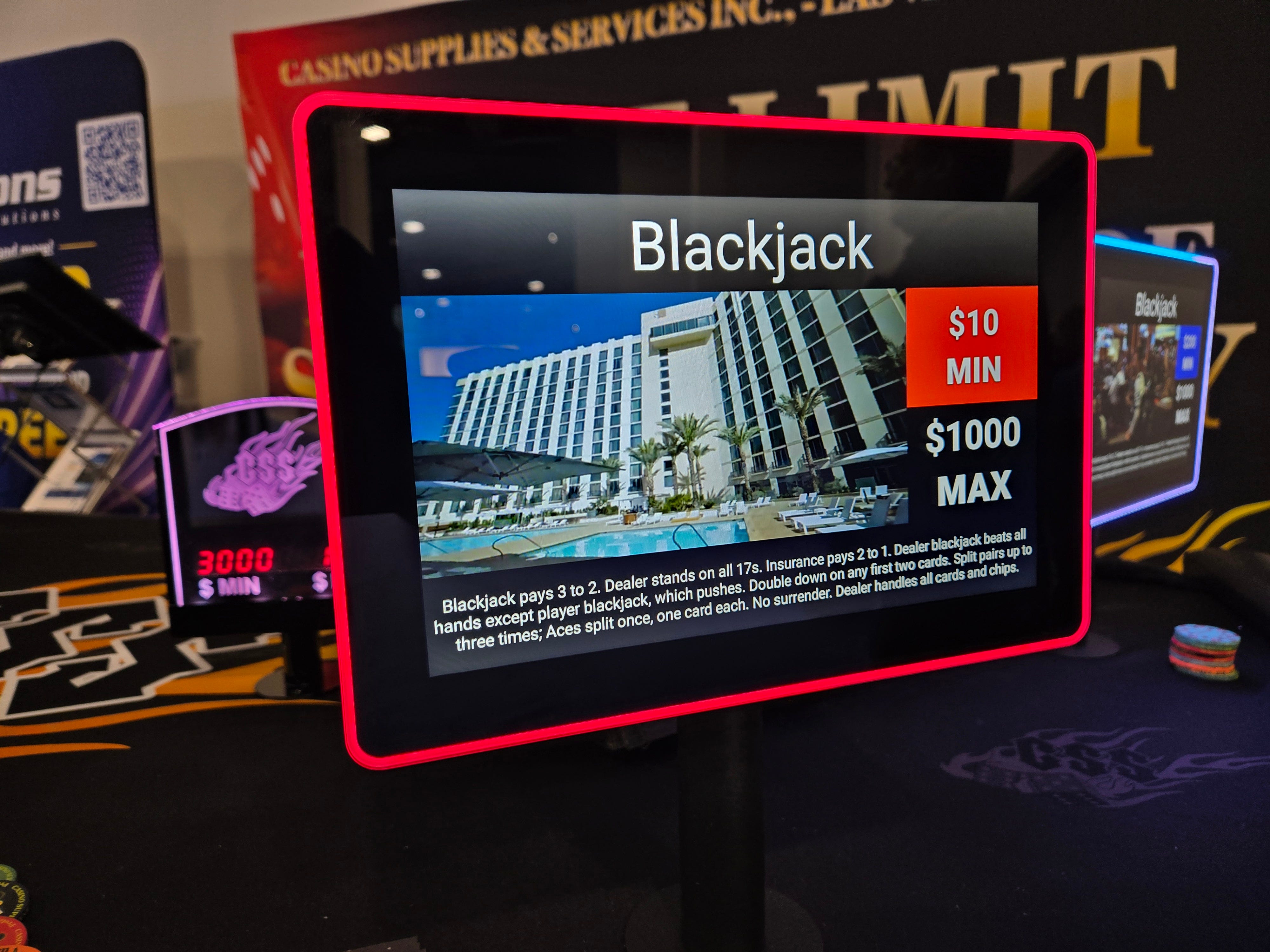
Together with Tom Cramer and Peter Connolly of TekVisions, they have developed the Peacock Pro, a table-limit and advertising display that you can see on most table games around Las Vegas. Its 10-inch touchscreen shows the minimum and maximum bets, with room for advertising and a color display that can be seen from across a crowded casino floor.
The displays link to a back-end software system that allows easy management, and the color-rich screens are perfect for rotating promotions. They’ve now sold 15,000 units to over 250 casinos throughout the country since 2017.
Some have tried, and failed, to knock-off the product. Other competitors have piled in a number of extra features, like cameras and AI, but the Peacock Pro remains simple and easy to use.
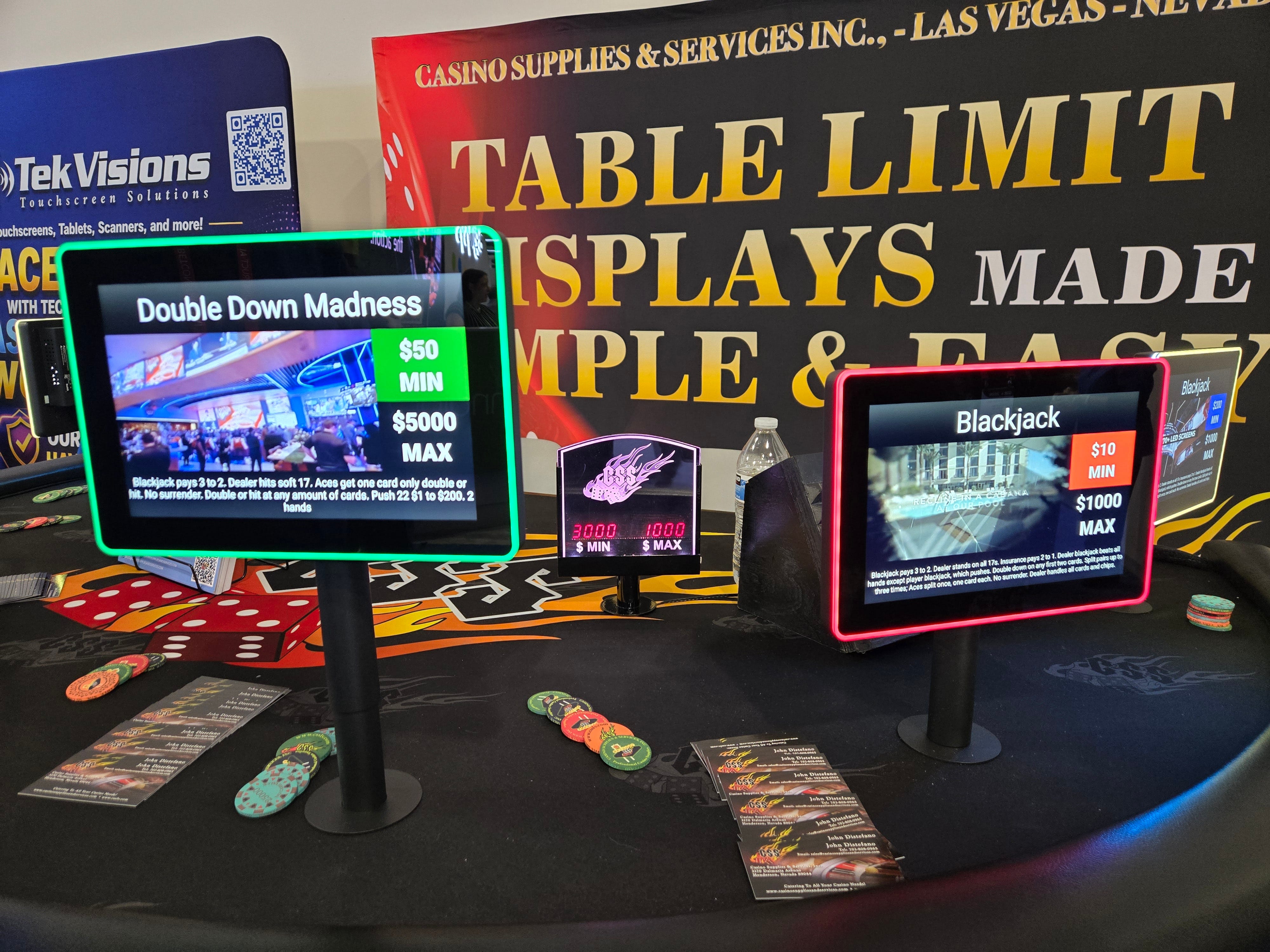
Over 15,000 casino displays have been sold to 250 casinos around the country.
Meanwhile, on top of a good product and an extensive catalog, Distefano answers the phone. Distributors are getting slower, prices are going higher, and even the largest casinos are just looking for someone to pick up the phone. In Nevada alone, he says about 80% of all of the casinos carry his products. Whether you’re one of the big players, like Caesars, Penn, or Boyd, or one of the many small casinos throughout the state, Distefano will pick up the phone.
“I’ve never turned down a customer. I didn’t care if you wanted a single roulette ball or if you wanted a hundred signs.”
Strange bedfellows
The combined TekVisions/Casino Gaming Supplies booth at 2026 Global Gaming Expo was just one small sliver of local flavor in an otherwise international affair, but all gaming issues are local in Las Vegas.
A glance at the seminar schedule can provide a lot of insight into the industry’s priorities. More than 70 sessions are spread out throughout the three days at Venetian, and the topics cover anything from casino security to player retention and VIP programs.
This year’s schedule featured more than 20 sessions devoted to AI, with a dozen more about prediction markets — two massive shifts to the way these companies have been doing business for a very long time.
One is an existential threat, as prediction markets threaten to undermine the way states have regulated gambling. AI, on the other hand, is seen as major step forward in technology by operators around the world.
The major keynote address on Tuesday featured CEOs from MGM Resorts, Caesars Entertainment, and Wynn Resorts, along with American Gaming Association’s President and CEO Bill Miller. Hockey’s own Wayne Gretzky stopped by, too. They were primarily focused on prediction markets.
“They have contorted the Commodity Exchange Act into something that is unrecognizable,” Miller said about companies like Polymarket and Kalshi, who have turned sports betting into commodities trading. The scheme avoids the licensing, taxation, and regulation that states like Nevada have worked so hard to build.
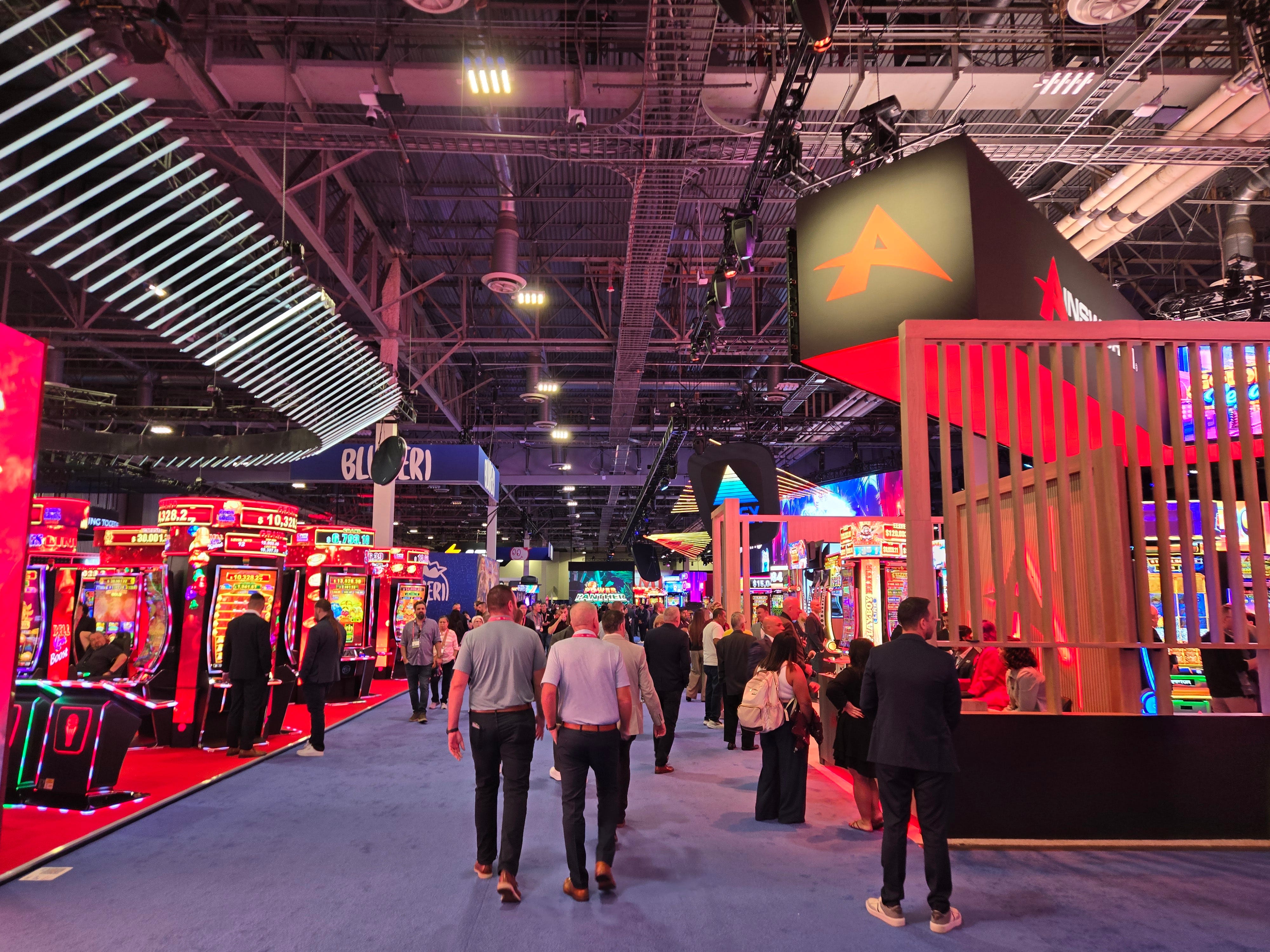
It was another successful casual shoes and sport coat convention.
“Prediction markets are hurting the industry, full stop,” MGM Resorts CEO Bill Hornbuckle said at Tuesday’s panel.
It’s also a major issue for tribal gaming companies, who were gatekept and shunned from G2E and the AGA until 2015. The two old courtroom foes are now friends as they circle the wagons against the threat of prediction markets.
The tribal prediction market battle is in California, where it has been argued that the contracts violate Indian Gaming laws. Tribal casinos are spread throughout the giant state, but there are also a few tribe-owned gaming operations throughout Nevada, and two major ones in Las Vegas. Avi Resort and Casino is near Laughlin on the Fort Mojave Reservation, while Wa She Shu Casino sits upstate in Gardnerville. It’s in a travel plaza, like other tribal gaming spots in Moapa and North Las Vegas. In Las Vegas, Palms is owned by the San Manuel tribe and The Mirage/Hard Rock will be owned by the Seminole Tribe of Florida.
Prediction markets rely on the Commodity Futures Trading Commission to exist, and states rely on local gambling control laws to protect their industry. Meanwhile, tribes draw leverage from federal Indian gaming laws, which have withstood a number of well-funded court challenges over the years.
It’s messy, but the industry stands to benefit in Nevada and California if this cooperation can keep up beyond their common enemies.
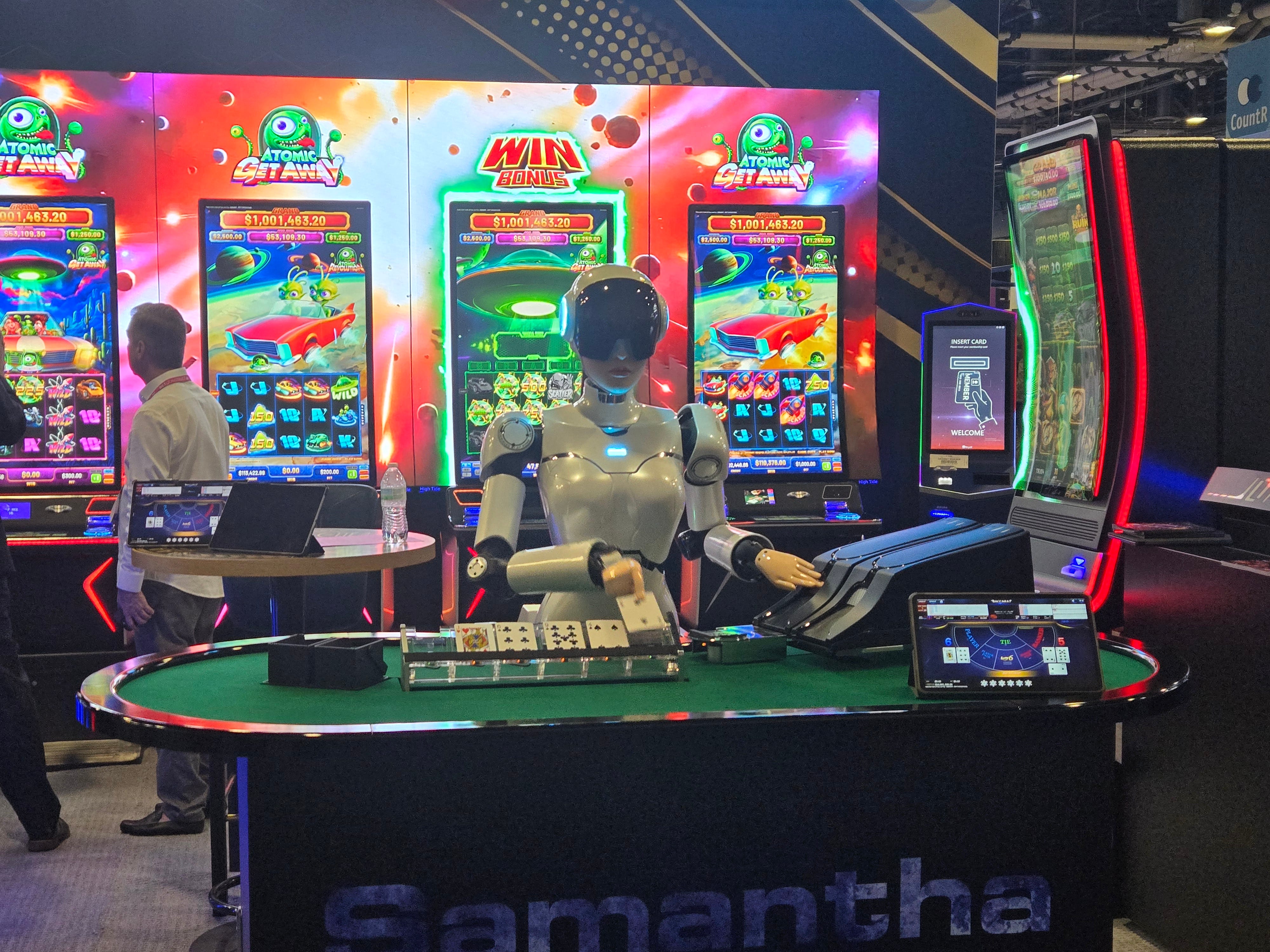
Humanoid robots are still a fixture at conventions of all types.
The prediction market issue is likely headed for the Supreme Court, with major consequences at stake for local gaming business, large and small. If prediction markets are allowed to continue with sports, the commodification of slot bets, table game bets, and even poker hands may not be far behind.
The industry is very excited about the possibilities. At a panel on Monday, Resorts World Director of Surveillance Zachary Koep called AI surveillance technology a “boon.”
“It’s amazing how many things you’re not aware of,” Koep told the panel.
Quite a few AI gaming companies have popped up in the last couple of years, and Resorts World is working with several of them. The technology can catch dealer mistakes, cheating players, and perhaps most importantly, create a perfect profile of guests.
“You get perfect player ratings,” Resorts World CEO Trevor Outman said. “Marketing knows exactly what players to reinvest into, to what degree.”
Casinos have been automating the way they perceive their customers since the beginning, and this is nothing new. New casino displays with AI surveillance features will replace some employees down the line. For now, a product like the Peacock Pro is designed to do exactly what it promises, and Distefano can focus on customer support instead of chasing innovation — with maybe a few small tweaks.
“It would be great if you had 3D stuff.”